If you’re dealing with court action because of debt (or you’re facing eviction or enforcement), you may be told to complete an N244 form. It can look daunting at first, but it’s simply the court’s general application form used to ask a judge to make a decision or change something that’s already been ordered.
In plain English, the N244 is the form you use to ask the court to do things like:
- Set aside a judgment (for example, cancel a County Court Judgment (CCJ) in certain situations)
- Vary an order (change payment terms set by the court)
- Suspend or stay enforcement (pause enforcement action, such as bailiff enforcement or eviction, while the court considers your situation)
It’s commonly used in debt and housing-related court cases, especially where something urgent needs to be reviewed by a judge.
When Would You Use Form N244?
People most often use an N244 when:
1) You want to set aside a CCJ
This is usually when you didn’t know about the claim, couldn’t respond in time, or there’s a strong reason the judgment shouldn’t have been made as it was. If a CCJ is set aside, it’s effectively cancelled and the claim process may start again.
2) You want to change payment terms set by the court
If the court decided how much you must pay (rather than you and the creditor agreeing it), an N244 can be used to ask the court to change that payment rate.
Important: In some CCJ situations, a different form (N245) is used instead — it depends on how the payment rate was set in the first place.
3) You need the court to pause enforcement
An N244 can be used to ask the court to suspend enforcement. For example, if bailiffs are involved or eviction is scheduled, an urgent N244 application may be used to ask the court to stop things progressing while the judge reviews your request.
Is There a Fee to Submit an N244?
In many situations, there is a court fee to submit an N244. The fee can vary depending on what you’re asking the court to do and whether a hearing is needed.
If you’re on a low income or certain benefits, you may be able to apply for help with court fees (fee remission). This is a separate application and can reduce the fee or remove it completely.
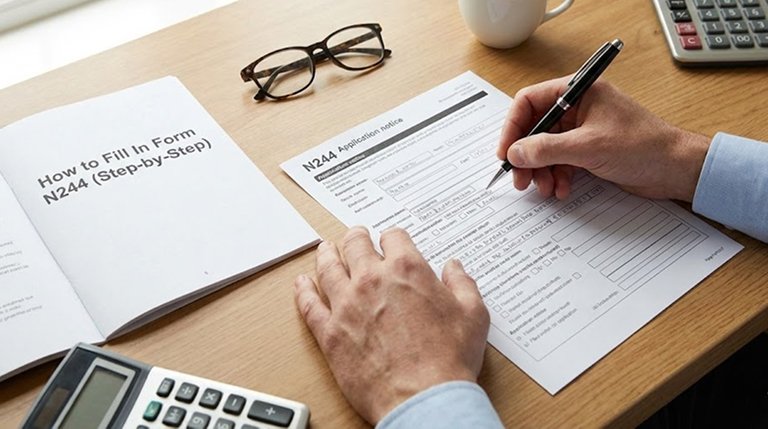
How to Fill In Form N244 (Step-by-Step)
The exact wording depends on your situation, but the structure is similar in most cases. Below is a practical guide to the most important parts.
Step 1: Get the case details right (top section)
At the top of the form, you’ll usually need:
- Name of court
- Claim number / case number
- Claimant’s name (usually the creditor/landlord/lender)
- Defendant’s name (usually you)
If your issue involves enforcement (for example, eviction), you may also need details from any enforcement notice (such as a warrant reference).
Step 2: Confirm who you are (Questions 1–2)
- Q1: Your full name (make sure it matches the court paperwork)
- Q2: Tick the box that describes your role (often Defendant)
Step 3: What you want and why (Q3)
This is where you clearly tell the court:
- What order you’re asking for, and
- Why you’re asking for it
Examples of what people ask for (worded simply):
- “I’m applying for the judgment to be set aside because…”
- “I’m asking the court to vary the payment order to £X per month because…”
- “I’m asking the court to suspend enforcement / suspend the warrant because…”
Keep it factual, specific, and tied to your circumstances.
Step 4: Draft order (Q4)
The form may ask whether you’re attaching a draft of the order you want the court to make. Many people tick No unless they’ve been advised to attach one.
Step 5: Hearing preferences (Q5–Q9)
The form asks how you want the application dealt with.
- In many situations, it’s sensible to request a hearing, because it gives you the chance to explain things directly.
- You may be asked:
- how long the hearing will last (people often put a short estimate)
- what level of judge (often District Judge for county court matters)
- who should receive (“be served with”) the application (usually the claimant/creditor)
Step 6: Your evidence and supporting statement (Q10)
This is where you explain the background and provide your reasons in more detail.
What to include depends on your situation, but commonly:
- What happened and when
- Why you couldn’t respond/comply earlier (if relevant)
- What has changed now
- What you can realistically afford (if asking to change payments)
- Any steps you’ve taken to resolve the issue (budgeting, advice, new income, etc.)
If there isn’t enough space, you can attach a separate sheet and write “See attached statement” in the box.
If you’re applying based on affordability
It’s a good idea to include a financial statement/budget showing:
- Income
- Essential spending
- What you can realistically pay (and why)
Step 7: Statement of truth, contact details, and signature
Read this carefully and sign/date it. Make sure your address, phone number and email are correct.
Step 8: Submit it fast (especially if enforcement is active)
If bailiffs or eviction are involved, timing matters. In some housing situations, bailiffs must give at least 2 weeks’ notice of an eviction date, but you should still act as soon as you receive notice.
Call the court to check the quickest way to submit (some courts accept email, others may require in-person or specific processes).
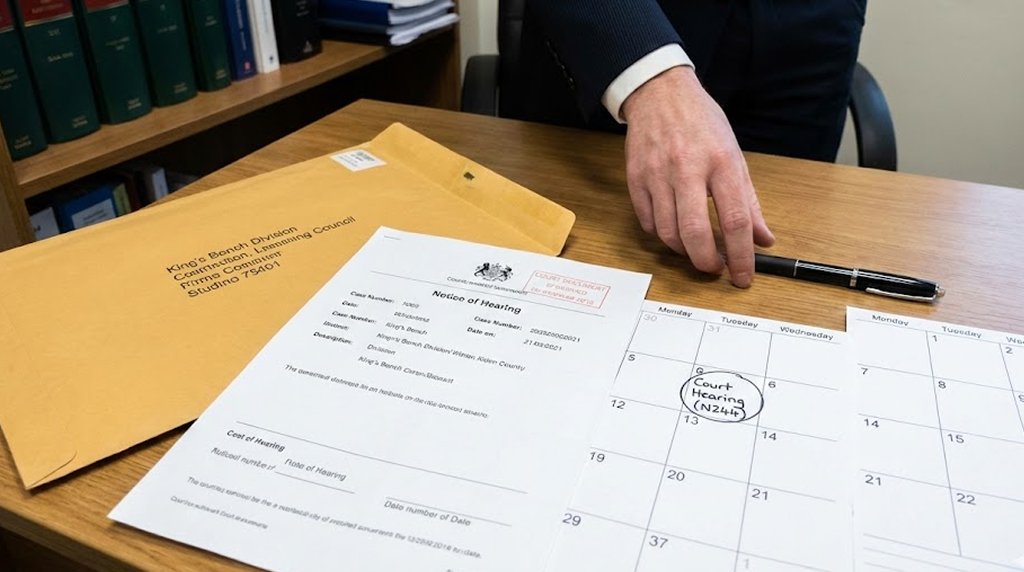
What Happens After You Submit an N244?
The court will decide whether:
- to list a hearing, or
- to deal with it without a hearing (depending on the application)
If enforcement is underway, the court may also decide whether to pause enforcement until the hearing/decision , but this is not guaranteed, which is why acting quickly matters.
An N244 form can be a powerful way to ask the court to reconsider a decision, change payment terms, or pause enforcement while your situation is reviewed. But the outcome depends on your circumstances, the evidence you provide, and how quickly you act.